Up the mast
Having completed the engine maintenance, I wanted to make sure that we were ready to sail as well as steam. This meant inspecting the rigging at the top of the mast, which in turn meant climbing the mast.
As a climber you'd think this would be a breeze for me. However, when people ask, I always say that I have a healthy respect for heights. This means in practice that I find heights scary, but not to the point where I'm paralysed with fear.
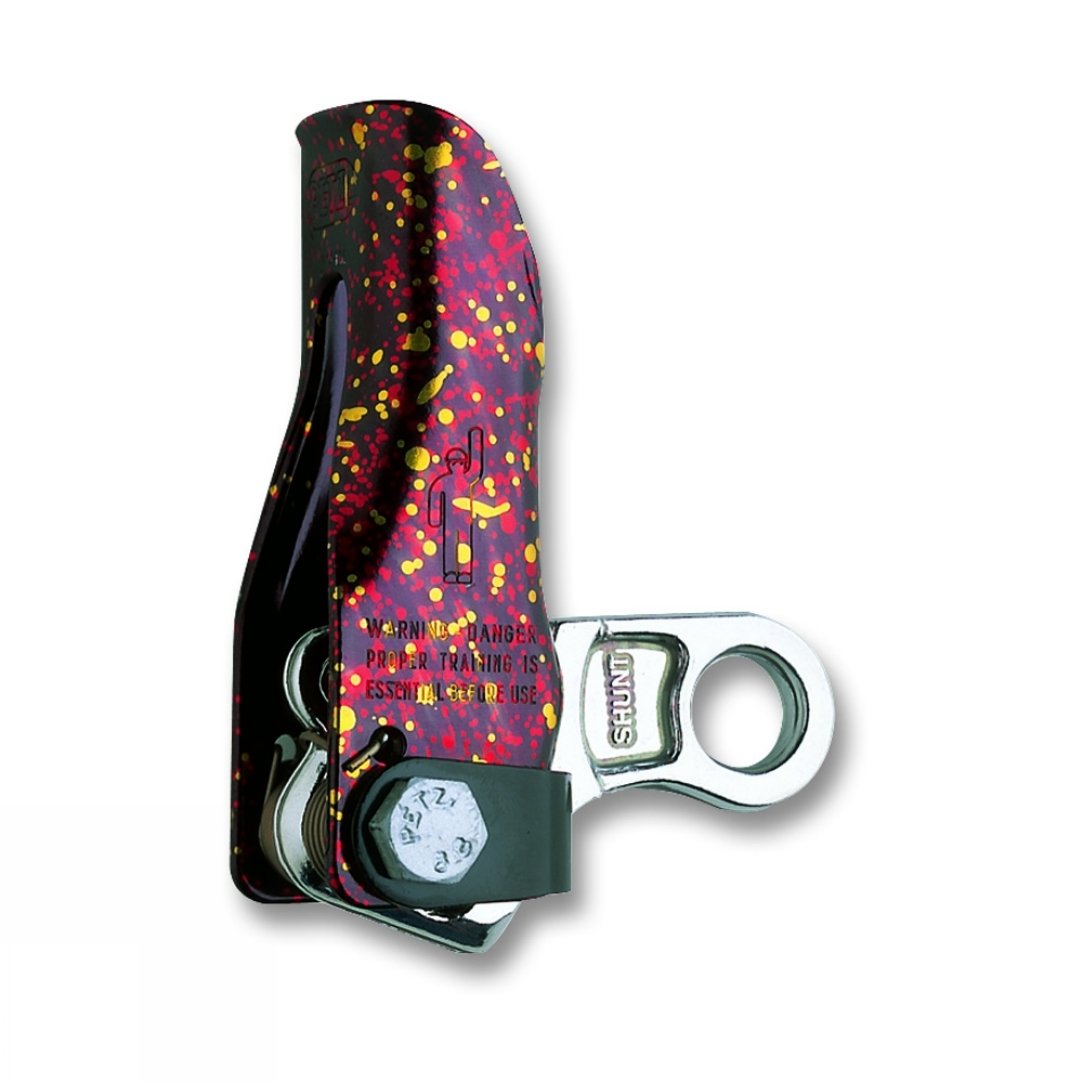
The previous owner of Alison put steps up the mast, so the actual climbing was not a problem. The only thing to sort out was how to secure myself whilst climbing. I decided to use my climbing harness, along with a Petzl Shunt attached to the main halyard.
The shunt is a very simple and versatile device. I've had mine 25 years and it's a testament to their design that you can still buy exactly the same model (with the same paint-job!) on a well-known shopping website.
The great thing about the Shunt is that you can either use it on a single rope, with the other end made fast, or on a double rope, which only requires it to be looped over something that won't fall down (in this case the top of the mast.
On Alison, the main and genoa halyards go over the top of the mast so the only way they're going to come down is if the rope snaps (which is highly unlikely) or the top of the mast falls off (which I guess is even less likely). It follows that the absolutely safest way you can ascend the mast is to use the Shunt in double rope mode so this was what I did for my first ascent.
Very quickly I ran into the first problem: The main halyard (especially a worn one) is a bit thicker than the shunt is really designed for. You can get the lines in with a bit of a struggle but pulling the shunt up requires two hands, one to pull the shunt up and the other to tension the rope. Since you also need to take your weight off the shunt to pull it up, you end up with one hand too few for the operation.
Luckily, my wife was on hand to watch out for me (and call the emergency services in case of disaster) so I asked her to tension the rope. Very quickly I ran into the second problem - the cross-trees! The halyard runs either side of it so in order to get past you have to take the shunt off and reattach it above the obstruction. I had brought along a sling in anticipation of this obstacle but it was getting quite blowy and I was getting pretty psyched so I decided to retreat and try another day when it was quieter.
The next Sunday dawned beautifully warm, sunny and still, more like late May than mid February (which we should remember is still officially winter in the UK). With no excuses left I decided to give it another go.
This time I decided to take the alternative approach of securing one end of the halyard and using the shunt on the other. The advantage of this approach being I could get straight to the top without having to unclip to move the shunt around the cross-trees. The disadvantage being I was relying on both the efficacy of my knot on the main halyard cleat and the strength of the cleat on the mast. Hey, ho, speed is safety as they say. I cleated the line off and scrambled on to the boom. I quickly found that I was suffering from the same problem - raising the Shunt required one more hand than I had. This time I was alone so I got around the problem by securing the loose end to the bottom step. With this in place I was able to move quickly and easily up the mast.
Very quickly I passed my previous high spot of the cross-trees and, ignoring the tight knot in my stomach, forged on to the top of the mast. With what I hoped was not a leap of faith, I sat back in my harness and gave the rigging as thorough an inspection as my jangling nerves would allow. I've watched quite a few Youtube videos on this and the consensus is that any problems will be visible well before you get an actual failure. Specifically I was looking for any cracks in any of the fixings and whether any of the strands in the wires had broken. As well as my eyes, I used my fingers to feel around for any cracks. Everything looked and felt fine so with a sigh of relief I got the hell out of there.


Comments
Post a Comment